Quick answer: A tuxedo and a dinner jacket are the same black-tie garment. “Tuxedo” is the American term and “dinner jacket” is the British one, though “dinner jacket” is also widely used for the white or colored version of the jacket. A suit is a matching jacket and trousers made entirely from one fabric, with no satin trim. That makes it less formal and suitable for business, daytime, and most weddings. The single fastest way to tell them apart: if the lapels are faced in satin or grosgrain, it’s a tuxedo (or dinner jacket). If they aren’t, it’s a suit.
Getting this right matters. Show up to a black-tie gala in a business suit and you’ll be underdressed. Wear a tuxedo to a daytime garden wedding and you’ll be overdressed. This guide breaks down every difference so you can dress correctly for any invitation, and it explains what to ask for when you’re having one made.
Contents On this Page
Key Takeaways
- Tuxedo = Dinner Jacket. Same garment, different country. Both belong to the black tie dress code.
- Satin is the giveaway. Tuxedos have satin or grosgrain lapel facings, covered buttons, and a matching stripe down the trousers. Suits have none of these.
- Suits are more versatile. You can wear a suit to the office, a wedding, an interview, or dinner. A tuxedo is for evening formal events only.
- The “white dinner jacket” is a warm-weather or summer black-tie option, worn with black tuxedo trousers.
- Fit matters most. A custom tuxedo or custom suit always looks more formal than a perfectly styled but poorly fitted rental.
At a Glance: Tuxedo vs Dinner Jacket vs Suit
| Feature | Tuxedo | Dinner Jacket | Suit |
|---|---|---|---|
| What it is | American term for black-tie evening wear | British term for the same garment; also the white or colored jacket version | Matching jacket and trousers in one fabric |
| Lapels | Satin or grosgrain-faced peak or shawl lapel | Satin or grosgrain-faced peak or shawl lapel (self-faced on some white versions) | Same fabric as the jacket, usually notch lapel |
| Buttons | Covered in satin/grosgrain, typically one button | Covered or self-fabric, typically one button | Horn, plastic, or metal, typically two buttons |
| Pockets | Jetted (no flaps) | Jetted (no flaps) | Usually flap pockets |
| Trousers | Satin/braid side stripe, no belt loops, worn with braces | Black tuxedo trousers with side stripe | Belt loops, no stripe |
| Shirt | White formal shirt with turndown collar, often pleated or piqué front | Same as tuxedo | Any dress shirt |
| Neckwear | Black bow tie | Black bow tie | Necktie (bow tie optional) |
| Dress code | Black tie, black tie optional | Black tie, warm-weather or resort black tie | Business, cocktail, lounge suit, most weddings |
| Time of day | Evening only (after 6 p.m.) | Evening only | Any time |
What Is a Tuxedo?
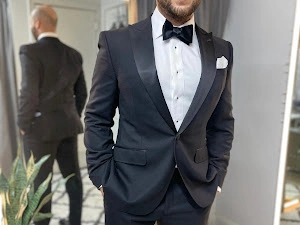
A tuxedo is a man’s formal evening outfit built around a jacket with silk-faced lapels, usually in satin or grosgrain, worn with matching trousers that carry a silk stripe down the outer seam. It’s the uniform of the black tie dress code, one step below white tie (tailcoats) in formality.
Defining features of a tuxedo
- Faced lapels. Peak lapels or shawl collars faced in satin or grosgrain. Notch lapels exist on tuxedos but are considered less traditional.
- Covered buttons. The buttons are wrapped in the same silk as the lapels.
- Jetted pockets. Slim, flap-free pockets keep the silhouette clean.
- Striped trousers. A satin or braid stripe runs down each leg. Traditionally there are no belt loops. Trousers are held up with side adjusters or braces (suspenders).
- Formal accessories. A black bow tie, a formal white shirt with studs and cufflinks, a cummerbund or low-cut waistcoat, and patent leather or highly polished black shoes.
Where the name “tuxedo” comes from
The word traces back to Tuxedo Park, New York, an exclusive enclave north of Manhattan. In 1886, members of the Tuxedo Club began wearing short, tailless evening jackets instead of formal tailcoats. The style spread across America and took the name of the town. The cut itself had already appeared in England a few decades earlier. Savile Row tailor Henry Poole & Co. is widely credited with cutting a short evening jacket for the Prince of Wales (later King Edward VII) in the 1860s. That makes the tuxedo, quite literally, a New York and London story. You can read more about its history on Wikipedia’s tuxedo entry.
Best for: black-tie weddings, galas, charity balls, award ceremonies, formal New Year’s Eve parties, opera and theater openings.
What Is a Dinner Jacket?
In the UK, Ireland, Australia, and much of the Commonwealth, “dinner jacket” (often shortened to “DJ”) is simply the everyday name for a tuxedo. An invitation in London reading “Dinner Jacket” or “Black Tie” means exactly what “Tuxedo” means in New York.
In American usage, however, “dinner jacket” has picked up a second, more specific meaning. It often refers to a tuxedo jacket in a color other than black or midnight blue, worn with standard black tuxedo trousers. The most famous example is the white or ivory dinner jacket, a classic summer and tropical black-tie option. Velvet dinner jackets in burgundy, emerald, or navy are another popular choice for holiday parties and evening receptions.
Defining features of a dinner jacket
- Same cut as a tuxedo jacket: peak or shawl lapel, single button, jetted pockets.
- Colored versions are often worn with black tuxedo trousers, not matching trousers.
- White and ivory versions sometimes have self-faced lapels (same fabric, no satin), which is traditional for warm-weather wear.
- Still a black-tie garment, worn with a black bow tie and formal shirt.
Best for: summer black-tie weddings, destination and beach-resort events, cruise formal nights, holiday parties, and grooms who want to stand apart from their groomsmen.
Style tip: A white dinner jacket is traditionally worn only in warm weather or warm climates. For a winter black-tie event in New York, a velvet dinner jacket in a deep jewel tone is the stylish alternative.
What Is a Suit?
A suit is a jacket and trousers (and sometimes a waistcoat, making a three-piece) cut from the same fabric, with no contrasting silk trim. The British call it a “lounge suit,” and that term still appears on invitations to signal a dress code below black tie. See the lounge suit entry on Wikipedia for background.
Defining features of a suit
- Self-fabric lapels, most commonly a notch lapel; peak lapels are popular on double-breasted and statement suits.
- Standard buttons in horn, corozo, or similar material, usually two or three on the front.
- Flap or patch pockets, sometimes with a ticket pocket.
- Trousers with belt loops (or side adjusters on more refined tailoring), with no side stripe.
- Wide range of fabrics and colors: navy, charcoal, gray, brown, and patterns such as pinstripe, windowpane, and herringbone.
Best for: business and office wear, interviews, daytime and semi-formal weddings, cocktail events, funerals, court appearances, and “business formal” or “lounge suit” dress codes.
A well-made custom suit is the most versatile item in a man’s wardrobe. A dark navy or charcoal suit can cover 90% of the events a typical man attends in a year.
The 5 Fastest Ways to Tell a Tuxedo from a Suit
If you’re shopping, renting, or just trying to read a room, look for these five details in order:
- Lapels. Shiny satin or ribbed grosgrain facing = tuxedo. Matching fabric = suit.
- Buttons. Fabric-covered = tuxedo. Horn or plastic = suit.
- Trouser stripe. A silk stripe down the leg = tuxedo.
- Pockets. No flaps = likely tuxedo. Flaps = almost always a suit.
- Neckwear. A black bow tie with a formal shirt usually signals black tie. A long necktie usually signals a suit.
Which Should You Wear? Decoding the Dress Code
Invitations rarely spell everything out. Here’s how to match each dress code to the right garment.
White tie
The most formal dress code. It calls for a black tailcoat, white piqué bow tie, and white waistcoat. Neither a tuxedo nor a suit is correct.
Black tie
A tuxedo or dinner jacket is required. Black or midnight blue is the classic choice. A white dinner jacket works in summer or warm climates, and velvet dinner jackets suit winter evening events.
Black tie optional
A tuxedo is preferred, but a dark, well-tailored suit (charcoal, navy, or black) with a conservative tie is acceptable. If you own a tuxedo, wear it.
Creative black tie
A dinner jacket in color, velvet, or pattern is ideal. This is the place for an emerald velvet shawl-collar jacket or a tonal jacquard.
Cocktail / semi-formal
A suit, ideally dark, with a tie. A tuxedo would be overdressing.
Business formal / lounge suit
A suit, with a tie.
Daytime wedding (before 6 p.m.)
A suit is traditional. Tuxedos are technically evening wear, so a navy, gray, or light-colored suit is the more correct choice for a daytime ceremony.
Tuxedo vs Suit for a Wedding: Which Is Right?
This is the question we hear most from grooms. The answer depends on three things.
1. Time of the ceremony. Evening weddings (after about 6 p.m.) suit a tuxedo. Daytime and afternoon ceremonies suit a suit.
2. The formality of the venue. A ballroom, cathedral, or historic hotel calls for black tie. A vineyard, beach, barn, or rooftop usually calls for a suit or a white dinner jacket.
3. How the groom wants to stand out. A popular approach: the groom wears a custom tuxedo or a white dinner jacket, while the groomsmen wear matching black tuxedos or coordinated suits. That visual distinction makes the groom the focal point in every photo.
Planning the whole wedding party? Explore our wedding suits and tuxedos for coordinated looks that fit everyone, from the groom to the ring bearer.
Can You Turn a Suit into a Tuxedo?
Not really. You can dress up a black suit with a bow tie and formal shirt, but it won’t read as black tie to anyone who knows what to look for, because the lapels, buttons, and trousers are all different. Adding satin to an existing suit is possible in theory, but the result rarely looks right.
The better investment is the reverse: one well-cut, custom black or midnight-blue tuxedo will last you for decades of formal events, and it costs less over time than renting three or four times.
Rent, Buy Off-the-Rack, or Go Custom?
| Option | Pros | Cons |
|---|---|---|
| Rental | Low upfront cost, good for a one-time event | Generic fit, worn fabrics, limited styles, no personalization |
| Off-the-rack | Yours to keep, faster than custom | Needs alterations, compromises on fit, especially for athletic or non-standard builds |
| Custom / made-to-measure | Cut to your measurements, your choice of fabric, lapel, lining, and details, lasts for years | Requires lead time and fittings |
If you already own an off-the-rack tuxedo or suit that doesn’t fit perfectly, professional tailoring and alterations can transform it. Adjusting the sleeve length, waist, and trouser break alone makes a dramatic difference.
Designing Your Own Tuxedo Details to Choose
When you order a custom tuxedo, these are the decisions you’ll make with your tailor:
- Color: Black (timeless), midnight blue (looks richer than black under artificial light), white or ivory (summer), velvet jewel tones (creative black tie).
- Lapel style: Peak lapel (most formal, elongating), shawl collar (elegant, rounded, vintage), notch lapel (least traditional).
- Facing: Satin (high-shine, classic) or grosgrain (matte, ribbed, understated).
- Closure: Single-breasted one-button (classic) or double-breasted (bold, no waist covering needed).
- Vents: No vents (most traditional) or side vents (more comfortable for movement and sitting).
- Fabric: Lightweight wool barathea or wool mohair for year-round wear; velvet for winter jackets; lightweight wool or linen blends for summer dinner jackets.
- Lining and monogram: A personal touch that only you know is there.
Frequently Asked Questions
Is a dinner jacket the same as a tuxedo?
Yes. “Dinner jacket” is the British term and “tuxedo” is the American term for the same black-tie garment. In the US, “dinner jacket” often refers specifically to a white, ivory, or colored tuxedo jacket worn with black tuxedo trousers.
What is the main difference between a tuxedo and a suit?
The main difference is satin. A tuxedo has satin or grosgrain-faced lapels, covered buttons, and a satin stripe down the trousers. A suit is made entirely from one fabric with no silk trim. Tuxedos are for evening formal events, while suits suit business and everyday occasions.
Can I wear a suit to a black-tie event?
Not to a strictly black-tie event, where a tuxedo is expected. For “black tie optional,” a dark, well-tailored suit with a conservative tie is acceptable.
Can you wear a tuxedo during the day?
Traditionally, no. Tuxedos are evening wear, worn from about 6 p.m. onward. For daytime formal events, a suit (or morning dress in the UK) is the correct choice.
Should a groom wear a tuxedo or a suit?
It depends on the wedding. Evening and formal ballroom weddings suit a tuxedo, while daytime, outdoor, and rustic weddings suit a suit. A white dinner jacket is a great middle ground for summer evening weddings.
What color tuxedo is most formal?
Black and midnight blue are the most formal colors. Midnight blue is often considered the more refined choice because it appears darker and richer than black under evening lighting.
Do you wear a belt with a tuxedo?
No. Traditional tuxedo trousers have no belt loops and are held up with side adjusters or braces (suspenders). A cummerbund or waistcoat covers the waistband.
How long does it take to make a custom tuxedo?
Most custom tuxedos take several weeks from first measurement to final fitting. Book your consultation at least six to eight weeks before your event to allow time for fittings.
Dress for the Invitation, Tailor for You
Here’s the simple rule: tuxedos and dinner jackets are for black-tie evenings, and suits are for everything else. The details (satin lapels, covered buttons, trouser stripes) are what separate them. But whether you choose a tuxedo, a dinner jacket, or a suit, the factor that matters most is fit. A garment cut to your body will always look more refined than the most expensive outfit that doesn’t fit.
At Maximus Custom Clothing, our family-run team of tailors in New York City crafts custom tuxedos, dinner jackets, and suits built to your measurements and your style, for weddings, galas, and every day in between.
Ready to get it right? Book your custom fitting appointment or contact our team to start designing your perfect formalwear.